Monday, 26 March 2012

India’s Defence Budget 2012-13
By Laxman K Behera,IDSA
March 20, 2012
The Union Budget 2012-13, presented to the Parliament on March 16, 2012 hiked the defence outlays to Rs. 1,93,407.29 crore (US$ 40.44 billion1). This represents a growth of 17.63 per cent over the previous year’s outlays – one of the highest increases in recent years excluding that for 2009-10 when the budget was increased by over 34 per cent, mostly to accommodate the pay hikes caused by the implementation of the recommendations of the Sixth Central Pay Commission. The increase in the latest defence budget was made possible by the expansionary fiscal policy adopted by the government in general. Further, although the increase looks impressive at first glance, it is not however driven by the modernisation needs as much as by manpower needs.
Defence Budget Escapes Economic Slowdown
The new defence budget comes at a time when the performance of the Indian economy is under stress and the prospect of recovery is tenuous. As theEconomic Survey 2011-12, presented to the Parliament a day before the Union Budget, puts it, GDP growth is projected at 6.9 per cent in the present fiscal year and at 7.6 per cent in 2012-13. These growth rates, which are significantly lower especially in comparison to the nearly 10 per cent growth registered in 2006-07, has however not forced the government to tighten its purse. Instead, it has resorted to what can be termed as fiscal profligacy, by increasing the overall central government expenditure by a hefty 18.54 per cent, with little regard for the fiscal situation. Consequently, the fiscal deficit, which the Finance Minister had promised in his previous budget speech to reduce to 4.1 per cent of GDP in 2012-13, is now projected to increase to 5.1 per cent. This expansionary fiscal policy has been the prime mover for the large increase in the budget of the defence ministry, which would otherwise have come under severe budgetary pressure if the Finance Minister had chosen a tight budget.
Key Aspects of the Defence Budget 2012-13
Although the latest defence budget has witnessed an increase of 18 per cent, the growth rate is only 13.15 per cent over the revised estimate of the now concluding fiscal year. In other words, the defence budget for 2011-12 has been revised upward by Rs 6,521.32 crore to Rs. 1,70,936.81 crore. However, unlike the revised estimate for 2010-11, in which both the Revenue Expenditure and Capital Expenditure were higher than their respective budget estimates, the revised estimate for 2011-12 shows an increase in Revenue Expenditure (by Rs. 9,576.32 or 10.06 per cent) and decline in Capital Expenditure by Rs. 3,055 (or 4.41 per cent).
The large increase in the defence budget notwithstanding, its impact on various components has been different (see Table). From the perspective of resource allocation, while the share of the defence budget in the GDP has marginally increased, its share in central government expenditure has fallen. One noticeable aspect of the new budget is that in comparison to Capital Expenditure, the Revenue Expenditure has increased faster. This growth has however been driven primarily because of the increase in pay and allowance of the armed forces, which has increased by 27 per cent to Rs. 63,182.46 crore, accounting for around 46 per cent growth of the total defence budget.
Table: Comparative Statistics of Defence Budgets, 2011-12 & 2012-13
| 2011-12 | 2012-13 | |
| Defence Budget (Rs. in Crore) | 164415.49 | 193407.29 |
| Growth of Defence Budget (%) | 11.59 | 17.63 |
| Revenue Expenditure (Rs. in Crore) | 95216.68 | 113828.66 |
| Growth of Revenue Expenditure (%) | 9.01 | 19.55 |
| Share of Revenue Expenditure in Defence Budget (%) | 57.91 | 58.85 |
| Capital Expenditure (Rs. in Crore) | 69198.81 | 79578.63 |
| Growth of Capital Expenditure (%) | 15.33 | 15.00 |
| Share of Capital Expenditure in Defence Budget (%) | 42.09 | 41.15 |
| Share of Defence Budget in GDP (%) | 1.83 | 1.90 |
| Share of Defence Budget in Central Government Expenditure (%) | 13.07 | 12.97 |
Note: Rs. 1.0 crore = Rs. 10 million = US$ 209,105.39
Shares in Defence Budget
The Army with an approximate budget of Rs. 97,302.54 accounts for 50 per cent of the latest defence budget, followed by the Air Force (Rs. 48,191.16; 25 per cent), Navy (Rs. 37,314.44; 19 per cent), Defence Research and Development Organisation (Rs. 10,635.56 crore; six per cent) and Ordnance Factories (Rs. 135.13 crore). It is noteworthy that compared to the previous year’s budget, Navy is the only service which has increased its share in total defence allocation (from 15 to 19 per cent). The Air Force’s share has decreased the most (by four percentage points), whereas the Army’s share has declined by one percentage point.
Figure: Share of Defence Services in Defence Budget 2012-13

Impact on Modernisation of Armed Forces: The Devil Lies in the Details
The 15 per cent increase in the Capital Expenditure has resulted in an additional amount of Rs. 10,379.82 crore. Given that most of the Capital Expenditure is incurred on modernisation of the armed forces, it is vital to see how the increase would affect each of the services. It is however to be noted that the three services (Army, Navy and Air Force) account for 94 per cent (Rs. 74,439.95 crore) of total Capital Expenditure in 2012-13, with the Air Force at the top with a share of 38 per cent (Rs. 30,485.35 crore), followed by the Navy (31 per cent or Rs. 24,766.42 crore) and the Army (24 per cent or Rs. 19,188.18 crore). Of the total Capital Expenditure of the three services, around 89 per cent (Rs 66,459.43 crore) is earmarked for capital acquisition or modernisation.2 These impressive figures do not however reveal the complete story. A closer look at the growth of the modernisation budget of 2012-13 would reveal that the focus is entirely driven by the Navy, which has got a 72 per cent hike (to Rs. 24,151.51 crore) in its modernisation budget. The Air Force’s modernisation budget has increased marginally (by 0.5 per cent) to Rs. 28,503.9 crore, while the Army’s has declined by three per cent to Rs. 13,804.02 crore.
The marginal increase in the Air Force’s modernisation budget and the decrease in the Army’s do not seem to be in sync with their modernisation requirements. This is more so given the pending signing of some of the big-ticket contracts (including the multi-billion dollar Rafael), and the sharp devaluation of the Indian rupee against the US dollar. As regards the latter, although the rupee has appreciated from its lowest point in mid-December 2011, the present exchange rate, which is around fifty rupees to a dollar, is still high and, if it remains at the same level could further erode the import capacity of the acquisition budget.
Return to Under-spending
When the defence budget 2011-12 was presented in February 2011, it gave an impression that the years of effort put in by the defence ministry to fine-tune its procurement process has finally yielded dividend. This impression now seems to be premature, as the defence ministry has once again come back to under-spending its capital budget. As the new budget reveals, of the total Capital Expenditure earmarked for 2011-12, Rs. 3,055 crore (4.41 per cent) has been surrendered at the time of revised estimate. The unspent amount could have been much higher if the Navy had not been allowed to overspend its allotted capital budget by Rs. 2801.25 crore (the Air Force and the Army together have surrendered Rs. 5,727.15 crore).
While the surrender in the Air Force’s modernisation budget is mostly from the head of ‘aircraft and aero-engine’, in the case of the Army the surrender is from a number of heads, including ‘aircraft & aero-engine’, and ‘other equipments’. The surrender of funds under such critical heads and of such magnitude not only reflects poorly upon budgetary management and the procurement system, but is also a cause of concern given the huge gap in national military capability and the rapid modernisation in neighbouring countries, particularly China which is pursuing an unprecedented level of military modernisation with a double-digit annual increase in defence expenditure for two decades. Given this scenario, the least that needs to be avoided by the services is the surrender of allotted funds. The defence establishment including the service headquarters therefore need to introspect and arrive at solutions that expedite procurement in a time-bound manner.
source: IDSA COMMENT
Saturday, 24 March 2012
Friday, 16 March 2012
China’s Defence Budget 2012: Implication’s For India’s Security – Analysis
March 15, 2012
source:Eurasia Review
‘However, its less the size of China’s defense budget than its composition that alarms beyond its borders. China’s military spending privileges the navy, air force and strategic nuclear forces—instruments of advanced power projection—rather than traditional defensive capabilities. No Chinese leader has yet explained how these capabilities contribute to China’s peaceful rise”. — Daniel Twining, Washington, USA.
Introductory Observations
China’s Defence Budget 2012 announced in the first week of March 2012 significantly draws global and regional attention in that China has shot through its defence expenditure over the $ 100 billion mark, making China’s military expenditure at the global level, second only to that of the United States, even though there exists a wide differential between the two.In terms of global concerns, China’s hikes in defence expenditures in 2012 military budget come under sharper scrutiny when China’s defence hikes are placed in the context of a sharp drop in United States defence budget by about $ 380 billion necessitated by US Congressional mandates. Though President Obama has reiterated that the Asia Pacific regional military posture of the United States would not be in the purview of budgetary cuts because of the new US strategic pivot to Asia Pacific, what cannot be ruled out is that in case of a sudden Middle East contingency, the United States would be forced to redirect US Forces from its strengthened posture against a fast militarily rising China.
Regionally in Asia, steep hikes in Chinese military expenditure cause multiple strategic and military concerns for China’s neighbours. Contextually, China’s recent aggressiveness and military assertion (facilitated by China’s military rise, fuelled by expanding economic resources) on territorial disputes foisted by China on virtually all its neighbours, multiply these concerns.
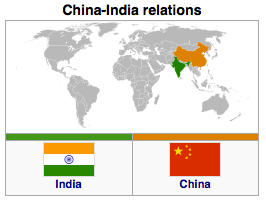
China - India Relations
China’s expanded military budget comes immediately after President Obama’s announcement of the policy of a strategic pivot to Asia Pacific. China denies that the two are connected. In this connection it needs to be pointed out that China would continue to increase its military expenditure irrespective of any strategic steps of the United States. China’s strategic aims are to emerge as the undisputed military power in Asia and a rival power centre on the global strategic calculus.
In this connexion, it needs to be pointed out that scientific projections have been made which state that China’s military budget hikes are expected to total $ 238.2 billion by 2015 which when translated amounts to more than doubling China’s military expenditure in just another three years. China’s existing military profile a before the announcement of Budget 2012 is considerably powerful and would become more powerful with $106 billion planned for this year. Doubling of the budget by 2015 would facilitate China’s military profile to emerge so powerful that no Asian country, not even India, can ever hope to militarily catch up with China.
India’s defence budget in the year ending was about $36 billion—a fraction of China’s military budget. Shockingly, a former Defence Secretary was quoted in the media that every year the Finance Ministry would demand in March that the Defence Ministry surrender Rs 5,000 crores or so to balance the deficit in the Union Budget. He further added that for the last ten years the Defence Ministry was being made to surrender such amounts. This would total to Rs 50,000 crores cut from announced Defence budgets. This year the news has come that the Defence Ministry has been ordered not to sign existing defence purchases agreements till after 31 March 2012 including the order to purchase the 126 fighter planes badly needed by the Indian Air Force. It is distressing that to balance the Finance Ministry books and Union budget deficits arising from exorbitantly wasteful schemes, the Government plays around with India’s war preparedness in an extremely hostile environment.
India should be more than seriously concerned about China’s hiked defence expenditures considering that ‘The China Threat’ to India is more real than to other nations, simply because China perceives that India is its sizeable and comparable strategic and military Asian rival and could impede China’s rise and emergence as the undisputed military power in Asia. Strategically, it is ironic that despite the credibility and potency of ‘The China Threat’, India’s political leadership and apex national security establishment traditionally disconnected from its Armed Forces who manage ‘The China Threat’, continue to de-emphasize this threat and get tricked into China’s protestations that China’s rise is a ‘peaceful rise’.
Against such a backdrop it becomes incumbent on India’s strategic community to highlight and reiterate the implications arising for India’s national security of China’s rising military expenditures. This Paper intends to do so under the following heads:
- China Defence Budget 2012: Salient Features and Thrust Areas for Military Up- gradation
- India’s National Security: Implications of China Defence Budget 2012
- Can India Ever Militarily Check-mate China?
China Defence Budget 2012: Salient Features and Thrust Areas for Military Up-gradation
Statistical data and comparative analyses of China Defence Budget abound in the international media and are not going to be repeated here. The aim in this Paper is to provide a macro-level overview the Chinese defence budget for 2012 and the issues arising from the salient features that will be examined. This part of the Paper intends to examine it under the following heads; (1) Chinese Defence Budget 2012 –salient details of increased military expenditure (2) Chinese official explanations for the increased military spending (3) Analytical explanations for China’s increased military spending, and (4) Main thrust areas for Chinese military up-gradation.Very briefly, Chinese military spending in 2012 is planned to increase by 11.2% to $106.4billion from $ 95.6 billion last year. China has on the average registered an annual increase of 12% in its defence spending. Between 2006 and 2011 China doubled its defence spending and by 2015 it will again be doubled. That indicates the colossal military expenditures that China has indulged in and what is going to be spent by China in the next three years. The strategic and political implications for the United States, China’s Asian neighbours and particularly India are serious, deep-rooted and long-range.
China’s official explanations are the traditional choreographed ones of defending national sovereignty, internal security and the requirement of protecting China’s long borders with fourteen countries and China’s long coastline. However, some official explanations forthcoming need to be quoted verbatim, and these are as follows:
- Chinese Prime Minister Wen Jiao Bao: “We will enhance the armed forces capacity to accomplish a wide range of tasks, the most important of which is to win local wars under information age conditions”.
- China NPC Official spokesperson and Former Foreign Minister Xao Zhing: “China’s limited military power is for the sake of national sovereignty, security and territorial integrity. Fundamentally, it constitutes no threat to other countries”.
- Professor Su Hao, Chinese Foreign Ministry University, Beijing: “There are new issues (that need funding) like the protection of citizens and investments overseas”
Analytically, one can advance a number of explanations for China’s increased military expenditures, the chief of which being are: (1) China’s present increase in military expenditure and doubling of that figure by 2015 is predictable in light of the United States strategic pivot to Asia Pacific which China perceives as US fencing-in of China (2) Chinese increased defence expenditures are aimed at upgrading of China’s military capabilities to deter any possible US military intervention against China or making it prohibitive (3) China’s quest for equal strategic weight with the United States would involve China’s military up- gradation to reduce the differential in the US-China military power.
China’s main thrusts in military up-gradation of its capabilities is obviously US-Centric in that China is aiming to dilute US military superiorities which can come in play militarily against China. However, Chinese enhancement in relation to the United States has more than disproportionate strategic impact on India. Contextually, in light of the preceding analysis China’s main thrust areas for sizeable military investments will be concentrated on the following:
- Second Artillery Corps which is entrusted with the management and operational use of China’s nuclear weapons arsenal and ballistic missiles arsenal. New generation of ICBMs and other missiles with greater emphasis on range and increased accuracy are in the pipeline.
- China Navy: China’s first aircraft carrier will be operational by the end of this year. China is planning to induct at least four aircraft carriers in the next few years. In terms of force projection, China is inducting amphibious warfare ships and logistics tenders. In terms of Chinese “anti-access and area denial” strategies against any United States possible military intervention, the Chinese Navy is planning introduction of land-based long range anti-ship missiles against US aircraft carriers, greater number of nuclear attack submarines, increased maritime reconnaissance and patrolling, and an overall increase in number of naval combat ships.
- China Air Force: China has planned a complete turn-over of its fighter aircraft fleet. Introduction of the J-20 Stealth Fighter planes is being speeded up. China has also expressed interest in the acquisition of the Russian SU-35 latest combat aircraft which competed for the Indian Air Force competition also. Up gradation of the bomber fleet and heavy lift strategic transport aircraft akin to the US C-17.-are in the pipeline to augment Chinese force-projection capabilities.
Not to be forgotten in terms of China’s military up-gradation is an increase of Chinese nuclear weapons arsenal. So far Chinese nuclear weapons arsenal has not been subjected to any strategic arms limitation treaty or any other scrutiny. The United States while raising hype on Chinese military up-gradations has steadfastly been muted on the subject of the increasing nuclear weapons stockpile of China.
Also to be noted is that China’s arms imports have shown a decrease indicating an increase in greater sophistication of its own R&D technological expertise and expanding defence production capabilities.
India’s National Security: Implications of China Defence Budget 2012 Analysed
India’s national security has consistently stood compromised by the persistent annual double digit increases in Chinese defence expenditure, and China Defence Budget 2012 is no exception. China crossing the $ 100 billion mark in defence expenditure in military plans for 2012 further accentuates and highlights India’s military unpreparedness to meet any possible Chinese military adventurism against India. In military budget comparisons itself, the Indian defence budget at about $36 billion pales into insignificance against China’s earmarked figure of $ 106.4 billion for 2012. The comparison gets more sombre when in comparison China faces no credible military threat from any global power or Asian power whereas India has pronounced military threats from an ever-military rising China and its strategic ally Pakistan, with comparable long and sea frontiers to protect against them—both of them having a record of military adventurism and an expanding nuclear weapons arsenal.Dispelling notions that one is advocating an arms race with China, it however needs to be noted and commonly understood within India and by Indians is that India’s defence postures against China are grossly inadequate both in terms of conventional military power and nuclear weapons and ballistic missiles. Suffice it to say that India today lacks both nuclear deterrence and conventional military deterrence against China. There is no such thing as minimum credible deterrence. Credible deterrence is relative to the adversaries strike capabilities to be effective.
In this Paper, I have no intention to draw a detailed comparative military balance between a military powerful China and an India where military up -gradations and effective war preparedness are at best given notional attention by the political leadership and apex national security establishment at best, and at worst a strategic obliviousness by both these entities arising from their strategic naivety in benign reading of Chinas military intentions underlying its recurrent and relentless military build-up.
The aim is to educate the India that exists outside the sphere of India’s apex national security decision-makers and the Indian Armed Forces hierarchy which gets disconnected from its political masters by Nehru’s archaic interposing of a strategic culture-deficit civilian bureaucracy of India’s Ministry of Defence.
India in relation to war preparedness to effectively meet ‘The China Threat’ can be said to be in the same repeat Nehruvian strategic mind-set of de-emphasis and under-playing of ‘The China Threat’ as that existed in the run-up to India’s 1962 military debacle foisted on the gallant Indian Army by its political leadership and its civilian bureaucracy. This assertion can be substantiated by Indian TV channels, particularly which stands reported having been pressurised to downplay Chinese intrusions into Indian Territory and not give them prominence.
The Chinese Prime Minister has reiterated this month and is quoted above, that China’s strategic aim is to win local wars under information age conditions and that is significant in relation to India for obvious reasons. Recently a high-powered committee in its report has been quoted in the media as having expressed that China is likely to make a military grab for portions of Ladakh and Arunachal Pradesh. This belated recognition of ‘The China Threat’ against India provides the setting for the succeeding brief examination of our ‘Defensive Postures” against China across the entire military spectrum. It is intended to do so under the following heads (1) India’s Nuclear weapons and missiles arsenal (2) Military postures in Ladakh and Arunachal Pradesh reviewed (3) Indian Air Force-the major voids (4) Indian Navy- Need for wholesale expansion (5) Strategic infrastructure along Himalayan Borders sadly neglected.
India’s nuclear deterrence against China is woefully inadequate both in terms of numbers and reach.Intrnational reports indicate that even Pakistan is outstripping India in this sphere. China accorded delayed grudging strategic respect to India only after the 1998 nuclear weaponization of India. The crying need is to make India’s ICBM operational which so far has been held back by India’s strategic timidity against US pressures. That materialization would greatly offset India’s current lack of dissuasive conventional military deterrence.
Military postures in Ladakh and Arunachal Pradesh have been analysed in fair detail in my earlier Papers. Briefly to be highlighted is that both the Ladakh and Arunachal Pradesh Sectors require force accretions in addition to those planned by an additional mountain division each and integral limited offensive capability. Protecting India’s national sovereignty involves boots-on-the-ground along the Himalayan borders which cannot be replicated by high technology. To that extent the argument of those who advocate a ‘leaner meaner military machine’ does not hold ground.
India’s skies stand naked against Indian military adversaries today with voids of nearly 150 combat fighter aircraft. It took the Indian decision-makers ten years to clear the choice of the next MRCA and even now the agreement is on hold due to Finance Ministry’s budget-deficit balancing. India’s transport aircraft fleet has out-lived its normal operational life and no replacements are in view. The switch to US inventories would carry its own problems. The Indian Air Force both in wartime and in peacetime too needs to be maintained at optimum levels in terms of its authorised aircraft holdings. Case exists for increasing the Indian Air Force combat squadrons to 45 squadrons—a figure that was recommended immediately in the wake of 1962 military debacle.
China has made no secret of its naval ambitions on a strong Chinese naval presence in the Indian Ocean and is working in a focused manner towards that ambition. China’s acquisition of four to six aircraft carriers, nuclear attack submarines and amphibious warfare capabilities, makes a strategic call on Indian decision-makers to embark on a wholesale fast-track expansion of the Indian Navy assets. India cannot afford to await 10-12 years lead times for materialization of naval orders to Indian shipyards. The biggest worry is the slippage allowed in replacement of the current fleet of submarines.
India’s’ strategic infrastructure along the Himalayan borders is sadly neglected The Prime Minister should have made a personal push in this direction as critical lifelines are 3-5 years behind schedule due to inter-ministerial wrangling. After the 1962 War with China some notable projects which needed speedy implementation were a double road artery to Tawang and Bumla in Arunachal Pradesh, a road tunnel under the Rohtang Pass for the alternative road to Ladakh, widening of the Rangli road axis to Jelep La in Sikkim and a major bypass of Gangtok with a highway to Nathu La. Space does not permit greater elaboration.
Lastly India’s decision making elite should answer as to why the Indian aeronautical industry which goes back to around 1943 has not been encouraged to become capable of fast-track development of Indian Air Force requirements of fighter aircraft and transport aircraft within the country.
Can India Ever Militarily Checkmate China?
Strategic analysis would suggest that it should be a pressing strategic imperative for Indian decision-makers to work towards a military checkmating of China to neutralise ‘The China Threat’ and in turn the Pakistan threat assiduously nurtured militarily by China. But the follow-up question is whether India can ever hope to militarily checkmate China and improve India’s security environment?Going by current trends of the Indian political leadership and the apex national security establishment of investing more on diplomacy than military preparedness to ward off ‘The China Threat’, the analytical answer is a big NO.
Checkmating China by India involves two major questions. Firstly, the political will and strategic audacity of India’s leadership to adopt a ‘hands-on’ approach to checkmate China, not as a strategic subsidiary of the United States but standing tall on its own two legs. Secondly, does India have adequate financial resources to bankroll increased defence expenditure to acquire substantial nuclear and conventional military deterrence to checkmate China from its current strategy in South Asia?
The answer to the first question is that it is unlikely that the existing mind-sets of India’s political leadership and apex national security establishment would undergo a change. Both these entities are likely to concentrate all strategic decision-making with themselves bypassing institutional inputs. Also keeping the Indian Armed Forces hierarchy out of apex level national security decision-making and more vitally nuclear weapons decision-making by these two entities leads to ‘mentally challenged’ strategic policy decisions. Political will and strategic audacity therefore cannot blossom in such a truncated decision-making environment.
The second question pertains to financial resources to bankroll sizeable defence expenditure to acquire substantial nuclear and conventional military deterrence against China. Financial resources are no longer a problem today for India. The Indian problem on increased defence expenditure is that massive amounts of the Indian budget are earmarked for non-productive political-populist schemes like NREGA and other subsidies which lead to substantial budget deficits and to offset which the Defence Budget becomes the notable casualty in terms of being asked to surrender thousands of crores of rupees every year before the presentation of the Budget.
The existing mind-set of underwriting wasteful expenditures on political-populist measures at the cost of Indian national security requires a complete transformation of policy approaches.
So the final answer is that India will never be able to militarily checkmate China’s enhanced military postures impinging on Indian security. If India’s political leadership under different political dispensations had been imbued with the will of checkmating China, they would not have allowed India’s slippage in its defensive postures and war preparedness, and kept pace with China’s constant military expenditure increases, not in an arms race, but in a sincere effort to not to allow the strategic and military chasm between China and India in terms of nuclear and conventional military deterrence differentials to grow.
Concluding Observations
China’s defence budgets every year have registered double-digit increases over the last two decades. This has facilitated China to emerge as the dominant military power in Asia and a contender capable of a serious challenge to United States global military predominance. China has achieved this posture by spending significant amounts on military expenditure facilitated by a booming economy.India in contrast also has a booming economy but it has been niggardly in its defence expenditures as defence expenditure is made subservient to political-populist schemes. Capital acquisition of critical military hardware are delayed for decades due to political indecision, bureaucratic lethargy and other considerations which view capital acquisitions of critical military equipment from abroad with extraneous perspectives.
Resulting from the above is the stark strategic reality that India will not be able to militarily checkmate China. In 1962, China militarily humiliated India due to lack of Indian defence preparedness in the preceding two decades. In 2012, with existing mind-sets at the highest-level in India and the slippage that has taken place in defence outlays in the last two decades, India risks a similar repeat 1962 performance of not a military debacle (thanks to the Indian Armed Forces used to making-do with military hardware available with them to defend India) but of a “strategic diminishment” of India on the global stage which India aspires to ascend.
India And The Chinese Threat
source: Eurasia Review
January 28, 2011
India’s China policy is going nowhere. The Chinese have bluntly declared that they will continue with their policy of issuing stapled visas as usual. Now the ball is in the Indian court. It is the Indian pride which is at stake – and it is not the India of 1962 when the Indian troops fought the Chinese without rudimentary battle uniform and were mauled.
It is time India conveys to the Chinese that it will be forced to review its One China policy if the Chinese pinpricks on Jammu and Kashmir continue. China must be made to understand the Indian sensitivities on Kashmir and that Kashmir is to India what Tibet is to China.
India did not sing the One China hymn in the joint communiqué that was signed at the conclusion of Chinese Premier Wen Jiabao’s recent visit to New Delhi. That may be pragmatic but not bold enough. India has to convey the ‘enough is enough’ message to the Chinese in concrete terms, in its back-channel as well as official contacts. India has to tell the Chinese that if they continue to give stapled visas to the people from the Indian states of Jammu and Kashmir and Arunachal Pradesh (no matter if in the case of the latter it is understood to be a ‘concession’ from the Chinese side) then India will retaliate in kind.
China may respond by using the Sikkim card and going back on its pledge to the then Prime Minister Atal Bihari Vajpayee that Sikkim is an integral part of India. But that should not deter India which is the third largest economy in Asia where China is number one. Let China go back on its commitment to India on Sikkim as it would only further expose the Chinese before the international community. In any case, the Chinese official media and Chinese tourist kits have several times portrayed Sikkim as an independent country even after the Chinese commitment. In June 2008 the PLA troops had intruded more than a kilometer into the “Finger Area” of Sikkim.
Prime Minister Manmohan Singh came up with unusually candid remarks on China during his meeting with editors in September 2010, though apparently he did not want to go on record. Nonetheless his remarks were widely quoted by mainstream print media. Singh said that China wanted to keep India bogged down in South Asia by playing on Indo-Pak tensions.
Sample a couple of quotes of Manmohan Singh on the subject:
- “India had to take adequate precautions but not give up hope of peaceful resolution of issues with China…in reaction to ‘pinpricks’ by Beijing on Jammu and Kashmir and other issues.”
- “China would like to have a foothold in South Asia and we have to reflect on this reality. We have to be aware of this.”
Upgrading India’s relations with Taiwan is another diplomatic option that is open to India but the Manmohan Singh government seems too timid to embark on such a bold move. Thus far, the position is that India does not engage with Taiwan officially. Taiwan does not even have a full fledged embassy in India. Indian officials — leave aside the ministers and the Prime Minister– ever engage with their Taiwanese counterparts officially. This paradigm has to change.
The Indian Prime Minister’s take on China has been corroborated by a recent opinion poll by Pew Global Attitudes Project which said that only 34 percent of Indians view China favourably—the second lowest number in Asia after Japan. This compared with 58 percent in Indonesia and 85 percent in Pakistan.
The Chinese pinpricks to the Indians are swelling by the day. They are flexing their military and diplomatic muscle with impunity and expect India to take it all in its stride. That is precisely what India has been doing so far. Take a military example.
China’s highest military planning body, Central Military Commission (CMC), recently approved building two new aircraft carriers. One aircraft carrier – Varyag of Kuznetsov class — is already under construction. All the three aircraft carriers will be available to China by 2017 and each one will patrol South China Sea, Western Pacific and Indian Ocean and will make the People’s Liberation Army-Navy (PLAN) a formidable power. The Chinese naval buildup has rung alarm bells in Japan and the US as China is trying to project to the world South and East China Seas as its areas of exclusive domain while it is of immense strategic interest to the international community that it has unfettered access to South China Sea, Western Pacific and Indian Ocean.
On the issue of sharing of water of rivers that are flowing from China to India, the situation is no different. The Chinese are going hammer and tongs against Indian national interests and following what they perceive to be best in their national interest. The series of dams that the Chinese are building on the Brahmaputra – 32 by British media account – is a case in point.
It is not just India that is facing problems from the Chinese dam-construction activities on international rivers. Myanmar too is feeling the heat. A new controversy has erupted between China and Myanmar over a multi-billion dollar dam construction project on the Longjiang River on the China-Myanmar border. The river, known as Shweli in Myanmar, flows through Shan state in Myanmar and eventually joins the Irrawaddy River in the Saigaing region. China has already built three dams on the Longjiang River that have substantially depleted the water levels of the river in Myanmar. The new dam will inevitably exacerbate this crisis further which will pinch the Myanmarese traders even harder as they depend on water transport for carrying merchandise. Besides, the new dam will trigger new social, environmental and ecological problems for the Myanmar government which already has its plate full. Large number of local people will be displaced in Myanmar which will heighten ethnic tensions.
This is what the Chinese are doing to their time-tested allies like Myanmar. It is any body’s guess what the Chinese will do to India which they want to see divided into thirty parts as has been so eloquently and publicly projected in the state-controlled Chinese media some time ago. The question is: when will the Indians ever learn and when will the Indian elephant finally muster the courage to respond?
(The writer is a New Delhi-based journalist-author and a strategic analyst. He can be reached at bhootnath004@yahoo.com )
Thursday, 2 February 2012
Let India unleash its soft power
source;The Hindu

The economic and moral decline of the West has created a hegemonic vacuum
that presents both a challenge and an opportunity to emerging powers.
Wars kill in more ways than one, and the longer they go on the
more do the ways multiply. The first war that proved this dictum was the Thirty
Years' War of 1618-48 in Europe. Through rape, murder, pillage, disease and
famine, it reduced the civilian population of southern Germany and the Lowlands
by 25- 40 per cent. The economic devastation it wrought took a hundred years to
repair. The American Civil war may have been the second for it killed 600,000
people (out of a population of 32 million) and so devastated the South that it
took a hundred years to recover. And had it not been for the Marshall Plan, a
similar fate would almost certainly have befallen Western Europe after the
Second World War.
Tragedy in Libya
A similar tragedy is unfolding in and around Libya.
Unsurprisingly, it has been hidden behind a veil of media inattention. But
nothing stays hidden forever. The shroud of silence was torn momentarily on
January 18 by a BBC World News telecast which reported that after three
consecutive droughts, Niger was being tipped over into famine by the return of
100,000 of its nationals as refugees from Libya.
If help did not come soon, people would begin to die. The
commentator grossly underestimated the impending tragedy, for on September 28,
The New York Times reported that 200,000 Nigerois, earning $600 a
month or more in Libya, had fled through the harsh Sahara to seek shelter in
their home country.
Niger is only one of a ring of perennially drought-prone countries
that had come to depend on the remittances from more than a million foreign
workers, who had found work in Libya. The other main beneficiaries were Chad,
Sudan, Eritrea and Somalia. Very few of these workers left voluntarily: in fact
‘pro-democracy peaceful protesters' “induced” them to go, by accusing hundreds
of their fellow countrymen of being African mercenaries, recruited by Muammar
Qadhafi to kill civilians, and hanging, burning or shooting them in full view of
YouTube's enthusiastic cineastes.
Today there are no jobs to return to, for Libya's economy lies in
ruins. The bulk of its urban infrastructure is damaged or destroyed; its oil
production is under half of the pre-war level. Since oil accounted for 75 per
cent of the state's revenue, the new government is no longer able to fund the
massive social security and subsidised food schemes that kept inflation below
one per cent in Qadhafi's Libya. Inflation, destitution, starvation and a
possible failed state stare many Libyans in the face.
The appeal from Niger is not the first of its kind. Other appeals
have been made in the past on behalf of Darfur, South Sudan, Somalia, and
Eritrea. India has so far believed that its responsibility ends with making
modest contributions to the World Food Programme. But as the already fragile
Saharan and sub-Saharan world disintegrates, it will be shirking its duty to
humanity if it does not do more — a lot more.
Need to do more
India needs to do more not only because with the former hegemonic
powers turning into predators a vacuum is developing from Pakistan to the
Maghreb. It has a duty to do more also because it can do more. India is
sitting on a food mountain, a part of which is rotting even as I write. At the
beginning of this month, the Food Corporation of India held 54.8 million tonnes
of food grains, This is 30 million tonnes more than its buffer-plus-strategic
reserve requires it to hold. With a second year of bumper harvests in the
offing, this can only rise further.
A single tonne of wheat will fully meet the needs of three
families of five for an entire year. A tonne of rotted wheat donated as cattle
feed will keep their cattle alive for the same length of time. Are we so
mean-spirited that we cannot spare a hundred thousand tonnes of wheat to save
the people of Niger? And why only Niger? Can India not set up a permanent,
half-million tonne wheat bank to be drawn upon by any sub-Saharan country in
distress?
And why stop at food grains? In drought-struck regions,
contaminated water kills much faster than hunger and takes the very young and
the very old first. The Indian pharmaceuticals industry is the envy of the
world, because it produces and sells medicines at a tenth to a thirtieth of the
retail prices abroad. Can Delhi not buttress its food aid with medicines and
vitamins? This will give an entirely new meaning to the concept of Soft Power
for, unlike the West in its present incarnation, it would be seeking to build
influence by protecting and preserving, not destroying; by expanding peoples'
futures instead of ending them in darkness.
We have been relatively slow to realise our full potential for the
exercise of soft power. This could be because of our too-ready acceptance of a
concept that was created by an American to address American foreign policy
concerns. In Joseph Nye's original definition, soft power originated in the
capacity to attract others to your country's culture, values and institutions.
Indian policymakers have taken this to heart and relied mainly upon India's open
society, democratic institutions, lack of aggressive intent and willingness to
share the burden of U.N. peacekeeping and policing the global commons, to garner
respect and support in the international community.
It is only in the last half-decade, as the Westphalian
international order crumbled and India's neighbourhood became increasingly
unstable, that New Delhi has begun to explore the economic dimensions of ‘soft
power' seriously. Afghanistan has been the focus of its initial efforts, and its
success is attested to by the threat (irrational though it is) that Pakistan
feels from it.
Since then, India has reached out with increasing confidence to
Bangladesh, Nepal and Africa. In January 2010, India created a line of credit
for Bangladesh of $1 billion, giving it valuable leeway for managing its
external account. Later in the year, Pranab Mukherjee announced a doubling of
aid to Nepal from Rs.1,600 crore to Rs. 3,200 crore. At Addis Ababa in May last
year, India added $5 billion to the $5.4 billion dollar line of credit it
extended to African countries in 2008 to “help them reach their development
goals.” All in all, India is soon going to be disbursing more than $3 billion in
aid every year. This is around the same amount as Brazil.
These are significant initiatives. If they have not been
sufficiently appreciated so far it could be because soft power is far more
difficult to exercise than ‘hard' military power. Its success depends less on
the amounts of assistance that a country is willing to render than on its
timing, the attention it is able to capture, and its palpable effectiveness. On
all three counts, India still has a good deal to learn.
India was the first to help Bangladesh after the 1997 cyclone that
claimed 150,000 lives, but so poor was the projection of its aid that western
and U.N. aid captured the world headlines. India's contribution to the
post-tsunami rescue in Sri Lanka and Indonesia got a little more notice, but
only a little.
In Sierra Leone in 1999, an undermanned Indian contingent of
troops did the initial peacekeeping under constraints imposed for reasons of
political correctness that no army commander would, or should, have accepted.
But all it received were jeers, while the credit for subjugating the rebels went
to a British contingent despatched in May 2000 that made its own rules of
combat.
Contrast with China
The contrast with China's methods of exercising soft power is
instructive. Beijing is frequently criticised, and occasionally resented, for
insisting on using its own enterprises, managers and workers, and
“transfer(ring) nothing to the country by way of knowhow.” But Chinese aid is
more effective than any that the world has seen so far. Projects get completed
in record time, at record low costs and, most of the time, to stringent
specifications. The locals may earn little directly, but no local politician,
crony contractor, or middleman gets a bite of the cherry. Some of the results
are mind-boggling: In Kenya, for instance, China has completed 1000 km of
motorways and 500 km of regular roads in three years to European standards and
transformed the lives and the economy of its people.
Brazil seems to have taken a leaf from China's book. It has the
largest official programme of aid to Haiti, amounting to $3.3 billion. And the
private charity that brought by far the most aid to Haiti after the earthquake
was a Libyan Trust run by Seif-ul-Islam-al-Gaddafi!
The economic and moral decline of the West has created a hegemonic
vacuum that presents both a challenge and an opportunity to emerging powers.
China and Brazil are already beginning to fill some of it. India cannot afford
to be left behind.
Let India unleash its soft power
byPrem Shankar Jha Share
source;the Hindu
'India set to become a soft power in world politics'
The economic and moral decline of the West has created a hegemonic vacuum that presents both a challenge and an opportunity to emerging powers.
Wars kill in more ways than one, and the longer they go on the more do the ways multiply. The first war that proved this dictum was the Thirty Years' War of 1618-48 in Europe. Through rape, murder, pillage, disease and famine, it reduced the civilian population of southern Germany and the Lowlands by 25- 40 per cent. The economic devastation it wrought took a hundred years to repair. The American Civil war may have been the second for it killed 600,000 people (out of a population of 32 million) and so devastated the South that it took a hundred years to recover. And had it not been for the Marshall Plan, a similar fate would almost certainly have befallen Western Europe after the Second World War.
Tragedy in Libya
A similar tragedy is unfolding in and around Libya. Unsurprisingly, it has been hidden behind a veil of media inattention. But nothing stays hidden forever. The shroud of silence was torn momentarily on January 18 by a BBC World News telecast which reported that after three consecutive droughts, Niger was being tipped over into famine by the return of 100,000 of its nationals as refugees from Libya.
If help did not come soon, people would begin to die. The commentator grossly underestimated the impending tragedy, for on September 28, The New York Times reported that 200,000 Nigerois, earning $600 a month or more in Libya, had fled through the harsh Sahara to seek shelter in their home country.
Niger is only one of a ring of perennially drought-prone countries that had come to depend on the remittances from more than a million foreign workers, who had found work in Libya. The other main beneficiaries were Chad, Sudan, Eritrea and Somalia. Very few of these workers left voluntarily: in fact ‘pro-democracy peaceful protesters' “induced” them to go, by accusing hundreds of their fellow countrymen of being African mercenaries, recruited by Muammar Qadhafi to kill civilians, and hanging, burning or shooting them in full view of YouTube's enthusiastic cineastes.
Today there are no jobs to return to, for Libya's economy lies in ruins. The bulk of its urban infrastructure is damaged or destroyed; its oil production is under half of the pre-war level. Since oil accounted for 75 per cent of the state's revenue, the new government is no longer able to fund the massive social security and subsidised food schemes that kept inflation below one per cent in Qadhafi's Libya. Inflation, destitution, starvation and a possible failed state stare many Libyans in the face.
The appeal from Niger is not the first of its kind. Other appeals have been made in the past on behalf of Darfur, South Sudan, Somalia, and Eritrea. India has so far believed that its responsibility ends with making modest contributions to the World Food Programme. But as the already fragile Saharan and sub-Saharan world disintegrates, it will be shirking its duty to humanity if it does not do more — a lot more.
Need to do more
India needs to do more not only because with the former hegemonic powers turning into predators a vacuum is developing from Pakistan to the Maghreb. It has a duty to do more also because it can do more. India is sitting on a food mountain, a part of which is rotting even as I write. At the beginning of this month, the Food Corporation of India held 54.8 million tonnes of food grains, This is 30 million tonnes more than its buffer-plus-strategic reserve requires it to hold. With a second year of bumper harvests in the offing, this can only rise further.
A single tonne of wheat will fully meet the needs of three families of five for an entire year. A tonne of rotted wheat donated as cattle feed will keep their cattle alive for the same length of time. Are we so mean-spirited that we cannot spare a hundred thousand tonnes of wheat to save the people of Niger? And why only Niger? Can India not set up a permanent, half-million tonne wheat bank to be drawn upon by any sub-Saharan country in distress?
And why stop at food grains? In drought-struck regions, contaminated water kills much faster than hunger and takes the very young and the very old first. The Indian pharmaceuticals industry is the envy of the world, because it produces and sells medicines at a tenth to a thirtieth of the retail prices abroad. Can Delhi not buttress its food aid with medicines and vitamins? This will give an entirely new meaning to the concept of Soft Power for, unlike the West in its present incarnation, it would be seeking to build influence by protecting and preserving, not destroying; by expanding peoples' futures instead of ending them in darkness.
We have been relatively slow to realise our full potential for the exercise of soft power. This could be because of our too-ready acceptance of a concept that was created by an American to address American foreign policy concerns. In Joseph Nye's original definition, soft power originated in the capacity to attract others to your country's culture, values and institutions. Indian policymakers have taken this to heart and relied mainly upon India's open society, democratic institutions, lack of aggressive intent and willingness to share the burden of U.N. peacekeeping and policing the global commons, to garner respect and support in the international community.
It is only in the last half-decade, as the Westphalian international order crumbled and India's neighbourhood became increasingly unstable, that New Delhi has begun to explore the economic dimensions of ‘soft power' seriously. Afghanistan has been the focus of its initial efforts, and its success is attested to by the threat (irrational though it is) that Pakistan feels from it.
Since then, India has reached out with increasing confidence to Bangladesh, Nepal and Africa. In January 2010, India created a line of credit for Bangladesh of $1 billion, giving it valuable leeway for managing its external account. Later in the year, Pranab Mukherjee announced a doubling of aid to Nepal from Rs.1,600 crore to Rs. 3,200 crore. At Addis Ababa in May last year, India added $5 billion to the $5.4 billion dollar line of credit it extended to African countries in 2008 to “help them reach their development goals.” All in all, India is soon going to be disbursing more than $3 billion in aid every year. This is around the same amount as Brazil.
These are significant initiatives. If they have not been sufficiently appreciated so far it could be because soft power is far more difficult to exercise than ‘hard' military power. Its success depends less on the amounts of assistance that a country is willing to render than on its timing, the attention it is able to capture, and its palpable effectiveness. On all three counts, India still has a good deal to learn.
India was the first to help Bangladesh after the 1997 cyclone that claimed 150,000 lives, but so poor was the projection of its aid that western and U.N. aid captured the world headlines. India's contribution to the post-tsunami rescue in Sri Lanka and Indonesia got a little more notice, but only a little.
In Sierra Leone in 1999, an undermanned Indian contingent of troops did the initial peacekeeping under constraints imposed for reasons of political correctness that no army commander would, or should, have accepted. But all it received were jeers, while the credit for subjugating the rebels went to a British contingent despatched in May 2000 that made its own rules of combat.
Contrast with China
The contrast with China's methods of exercising soft power is instructive. Beijing is frequently criticised, and occasionally resented, for insisting on using its own enterprises, managers and workers, and “transfer(ring) nothing to the country by way of knowhow.” But Chinese aid is more effective than any that the world has seen so far. Projects get completed in record time, at record low costs and, most of the time, to stringent specifications. The locals may earn little directly, but no local politician, crony contractor, or middleman gets a bite of the cherry. Some of the results are mind-boggling: In Kenya, for instance, China has completed 1000 km of motorways and 500 km of regular roads in three years to European standards and transformed the lives and the economy of its people.
Brazil seems to have taken a leaf from China's book. It has the largest official programme of aid to Haiti, amounting to $3.3 billion. And the private charity that brought by far the most aid to Haiti after the earthquake was a Libyan Trust run by Seif-ul-Islam-al-Gaddafi!
The economic and moral decline of the West has created a hegemonic vacuum that presents both a challenge and an opportunity to emerging powers. China and Brazil are already beginning to fill some of it. India cannot afford to be left behind.
Subscribe to:
Posts (Atom)